Deutsch

Freight services
Nuremberg forms one of Germany's largest freight hubs with its marshalling yard, second only to Hamburg-Maschen. Freight flows from all four points of the compass meet and mix in Nuremberg. They will change on completion of VDE 8, particularly because of the line upgrade between Ebensfeld and Nuremberg. Trains which currently run further to the west or cannot enter the Alpine region from the Baltic or North Sea coast at all will be shifted on to the south-north axis from Nuremberg to Bamberg, Lichtenfels, Erfurt and further north. The Nuremberg – Ebensfeld line upgrade will not only create paths for long-distance, regional and local traffic, but also new capacity for rail freight.
Freight trains from Bamberg via Erlangen, Eltersdorf and the "Fürth loop" currently run straight into the residential areas of Fürth and Nuremberg. Once they have cleared Fürth Hauptbahnhof, they have to branch off to the south, crossing the busy Nuremberg – Würzburg line on the level, interfering with both passenger and freight traffic. This frequently causes delays to passenger services. This situation will worsen considerably with the increase in passenger services from Nuremberg and Fürth to the north. Crossing on the level as at present will no longer be possible when the Nuremberg – Ebensfeld line and the rapid transit system have been fully upgraded. Viable train paths will only be available at night, when there is less passenger traffic
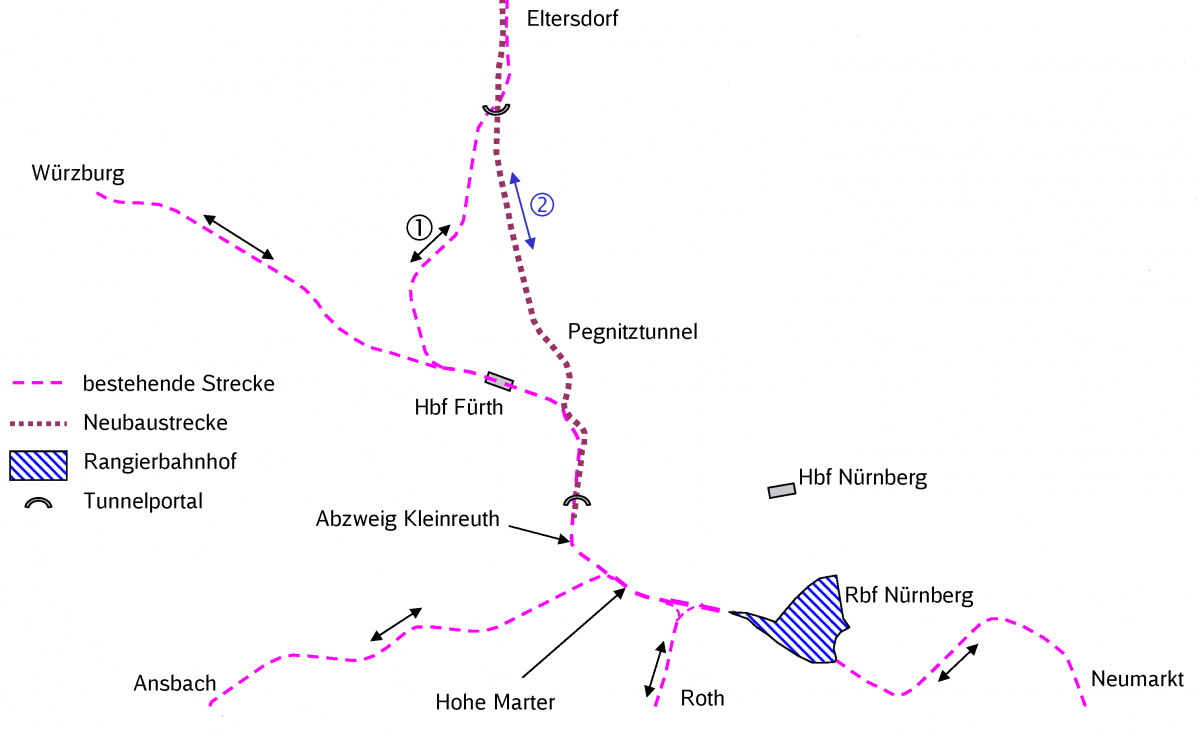
After crossing the line between Nuremberg and Fürth, freight trains currently continue on line 5950 towards the marshalling yard or branch off towards Eibach/Roth before they reach it. About 50% of the trains run to the marshalling yard and about 50% continue directly southwards.
It is well known that daily freight traffic fluctuates depending upon demands and requirements for transport. Unlike passenger traffic, in which services usually run to a clockface timetable and use the same consists, the length and composition of a freight train can vary widely. Trains over 700 m long do not usually run in Germany. They are frequently shorter. The length usually depends on the haulier's, e.g. Rallion's, demand for transport. Some freight trains run to a fixed timetable, also operating if the maximum length is not reached. Anticipated freight train movements can thus be forecast on the basis of operational experience and technical and economic development. Such forecasts are usually made on behalf of the German Federal Ministry of Transport and recorded in Federal Transport Infrastructure Plans (BVWP). Commissioning of the freight route has been announced for the end of 2021. The updated BVWP with a horizon of 2025 thus has to be used.
Various surveys have shown that there is interest in how many trains run, when they run and where they go. As aforementioned, these aspects are the subject of forecasts and operational assumptions. However, a distinction must always be made between trains which actually run, e.g. according to the current annual timetable, and the capacity provided by a line. As line capacity cannot be increased or reduced at will on the railways, reserves always have to be planned in. This has a particular effect on such unique structures as the Pegnitz tunnel, as an extra track cannot simply be added. Capacity for 2025 after full upgrading of the Nuremberg – Ebensfeld line has therefore been used as a basis for planning this line and the tunnel.
| Freight trains in a 24-hour period | ||
|---|---|---|
| Line 1 Up*/Down | Line 2 Up*/Down | |
| Timetable in 2011 | 44/48 | 0/0 |
| Forecast for 2025 *** | ||
| Line 1 Up*/Down | Line 2 Up*/Down | |
| Anticipated traffic | 20**/20** | 148**/150** |
|
* Up = Eltersdorf Fürth bzw. Eltersdorf Abzweig Kleinreuth; Down = opposite direction ** Die tatsächliche Anzahl ist abhängig von der Fahrplanbestellung der Eisenbahnbetriebsunternehmen ab 2021. *** Dies setzt den vollständigen Ausbau der ABS Nürnberg-Ebensfeld voraus. |
||
The forecast assumes that the vast majority of trains will pass through the Pegnitz tunnel. However, there will still be trains which travel via Fürth, if line capacity permits and the train's destination renders this necessary, as not every train has to go to the marshalling yard or on to Roth.
The forecast used will create future-proof line capacity. National rail freight development has also shown that this traffic will continue to grow strongly.
Freight line 5955 under discussion here will terminate at the new Kleinreuth junction, where the double-track tunnel section meets the double-track surface line from Fürth. This junction will be located in the vicinity of the Wallensteinstrasse road bridge. Any further improvement and upgrading work will, however, not form part of this VDE 8.1 sub-project.
 Information Centres
  New travel times & lines
  Construction site info
 Press releases
  Youtube channel
  Contact