Deutsch

Ground exploration
One of the most important prerequisites for the construction of a railway line and particularly a tunnel is accurate knowledge of the condition of the subsoil. An extensive exploration programme has been conducted over the last two years, in addition to previous exploration, with a view to achieving the greatest possible accuracy of planning for the freight line project.
The subsoil was probed for any munitions left over from the Second World War before the exploratory work commenced, to preclude dangers to residents and drilling crews.
About 1900 m of bores were sunk in 2010, to examine the subsoil between Nuremeberg-Kleinreuth and Fürth-Steinach in more detail. Vertical and diagonal coring was carried out, additional groundwater measurement points established and the subsoil explored by trial excavation and dynamic probing.
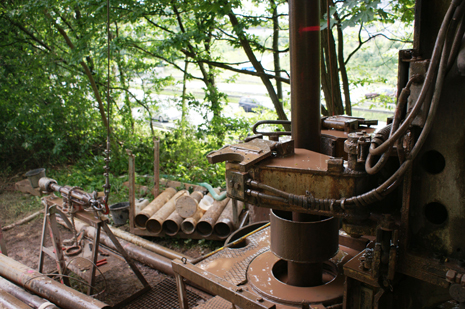
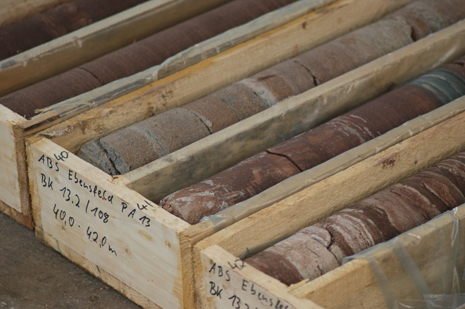
In recent months, the samples taken and laboratory tests carried out have been evaluated, prepared and collated to form a subsoil report, which included the results of earlier exploration programmes.
The supplementary tests provided further important data for the design of the TBM. In addition, the concentrated knowledge of the local groundwater conditions in Nuremberg and Fürth were used to plan safe tunnel driving. Driving the tunnel was simulated by computer, using a three-dimensional groundwater model. The effects on groundwater can be forecast on the basis of this simulation and the necessary counter-measures derived. The groundwater will be comprehensively monitored before and during construction too, in order to log the predominant groundwater conditions in detail.
Facts and figures
| Core bores (Maximum approximate depth 50 m): |
61 |
| Probe bores (small bore): |
15 |
| Heavy dynamic probing (Maximum approximate depth 20 m: |
64 |
| Trial excavation exploration points (Maximum approximate depth 4 m): |
16 |
| Creation of groundwater measurement points (Diameter 6“): |
8 |
 Information Centres
  New travel times & lines
  Construction site info
 Press releases
  Youtube channel
  Contact